
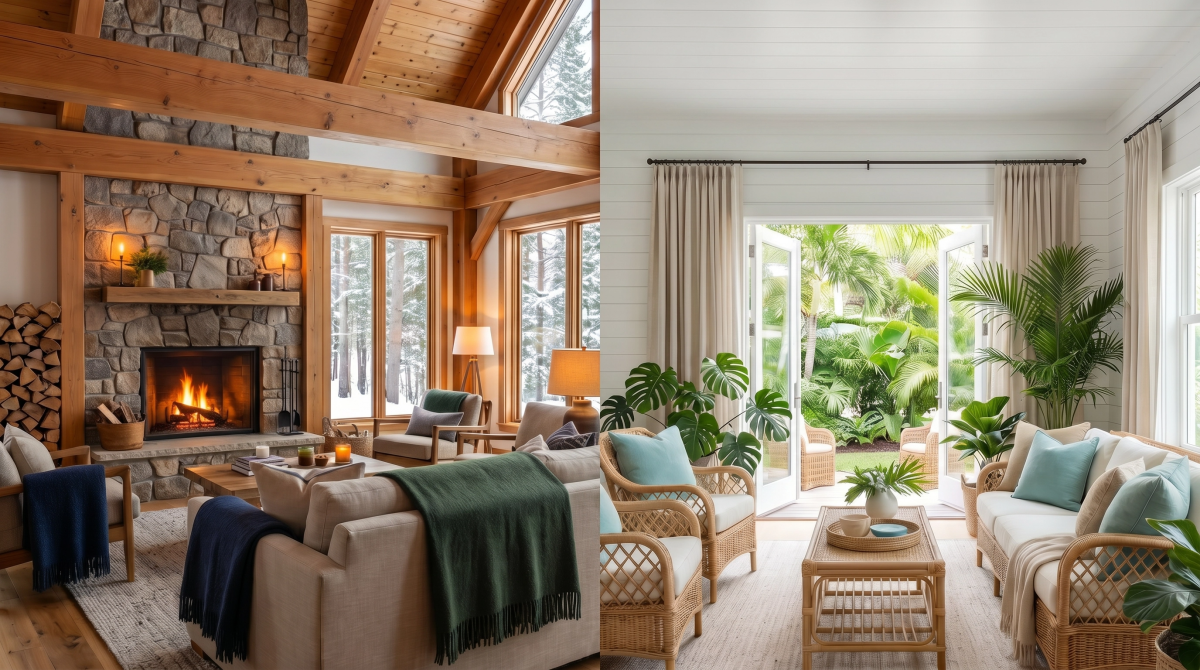
If you split your time between a Michigan home and a Florida retreat, you already know the feeling: you love both spaces, but they feel like they belong to two completely different people. One is cozy, layered, and grounded in the deep tones of a Great Lakes winter. The other is breezy, light-filled, and coastal. The good news is that a thoughtfully designed home in both climates can feel unmistakably like you—connected by a shared visual language that travels with you, no matter the season. With the right approach to color, materials, and furnishings, your two homes can feel like one beautiful story told in two chapters.
Table of Contents
- Why Cohesion Matters More Than Matching
- Building a Shared Color Palette That Works in Both Climates
- Choosing Materials and Textiles That Travel Well
- A Smart Furniture Strategy for Two-Home Living
- Carrying Your Personal Details Across Both Homes
Key Takeaways
| Design Priority | What It Means in Practice |
|---|---|
| Cohesion Over Matching | Your homes don’t need identical furniture—they need a shared visual identity through color, texture, and style direction. |
| Climate-Appropriate Materials | Choose fabrics and finishes suited to each environment while staying within the same design family. |
| A Grounding Color Palette | Two or three anchor colors used in both homes create continuity without repetition. |
| Flexible Furniture Choices | Pieces in natural materials like wood, rattan, and linen work beautifully in both northern and coastal settings. |
| Personal Touchstones | Recurring art styles, a signature scent, or consistent decorative objects make both homes feel like home immediately. |
Why Cohesion Matters More Than Matching
There’s a temptation, when decorating two homes in very different climates, to treat each one as a completely separate project. And while each space should absolutely respond to its surroundings, letting them drift too far apart creates a subtle disorientation. You walk into your Florida home after a long Michigan winter and it doesn’t quite feel like yours yet. You spend the first few days readjusting rather than relaxing.
Design researchers have long noted that our sense of “home” is tied to visual and sensory consistency. Studies on environmental psychology suggest that familiar visual cues—specific colors, recurring textures, a recognizable layout logic—trigger a feeling of safety and belonging almost immediately. When your two homes share a design language, the transition between them becomes seamless. You don’t have to “arrive” at either space. You’re already there.
Cohesion doesn’t mean your Michigan living room and your Naples sunroom should be decorated with the same furniture. It means they should feel like they were designed by the same person, for the same person. Think of it the way a well-dressed person might wear cashmere in January and linen in July—the fabrics change completely, but the aesthetic sensibility is the same.
Pro Tip: Before starting any design project for either home, create a single mood board that captures your overall aesthetic identity—not “Michigan” and not “Florida,” but just you. Use that board as the filter for every decision in both spaces.
Building a Shared Color Palette That Works in Both Climates
Color is the single most powerful tool for creating cohesion across two homes. When your Michigan and Florida spaces share two or three anchor colors—even used in different proportions or applications—your eye registers them as related the moment you walk in the door.
The palettes that tend to work beautifully in both climates are grounded in warm neutrals: think soft whites, sand, warm greiges, aged linens, and muted sage. These tones read as calm and refined in the bright, natural light of a Florida interior without looking washed out. In a Michigan home where winter light is softer and more filtered, those same tones feel warm and enveloping rather than stark. Architectural Digest notes that undertone consistency—choosing warm-based or cool-based neutrals and staying within that family—is what separates a palette that feels intentional from one that feels accidental.
Here’s a practical way to think about it: choose one primary neutral that appears in significant quantities in both homes (walls, large upholstered pieces), one secondary accent color that shows up in both spaces in smaller doses (pillows, art, a single painted piece), and one grounding darker tone used for contrast in both. The specific applications can vary—your Michigan home might use the dark tone on a moody library wall, while your Florida home uses it only in drapery hardware and picture frames—but the colors themselves are the same. That’s all it takes to create a throughline.
| Palette Role | Michigan Application | Florida Application |
|---|---|---|
| Primary Neutral (e.g., warm white or sand) | Walls, upholstered sofa | Walls, linen drapery |
| Accent Color (e.g., muted sage or dusty blue) | Throw pillows, artwork, a single chair | Outdoor cushions, ceramic vases, bedding |
| Grounding Tone (e.g., deep walnut or charcoal) | Accent wall, dark wood furniture | Drapery rods, art frames, decorative objects |
Pro Tip: Order actual paint samples in your Michigan home and photograph them in both morning and afternoon light before committing. Florida light is significantly brighter, so a color that reads as a soft sage in Michigan may look nearly white in a south-facing Florida room. Always test on-site before finalizing.
Choosing Materials and Textiles That Travel Well
Material choices are where climate differences become most practical. Michigan winters call for layered textiles—wool throws, velvet accent pillows, heavier drapery that insulates against cold windows. Florida’s heat and humidity demand breathable, wipeable, and fade-resistant materials that can handle both sun exposure and the occasional splash from a pool. These needs aren’t contradictory. They just require a little strategic thinking.
The materials that translate most naturally across both climates tend to be natural ones: solid wood (particularly lighter oak, white oak, or teak for coastal settings), rattan and cane, linen, and stone. Design editors consistently point to natural materials as the most timeless and climate-adaptable choices in residential interiors, precisely because they don’t read as “seasonal.” A rattan side table looks just as intentional in a snowy Michigan cottage as it does in a Florida lanai. A honed marble countertop works beautifully in both a warm Michigan kitchen and a bright Florida one.
Where you’ll want to make climate-specific adjustments is in the soft goods. In Michigan, you can lean into heavier fabrics—boucle, mohair, flannel—for upholstered pieces that you wouldn’t subject to Florida humidity. In Florida, favor performance fabrics (Sunbrella-type weaves, outdoor-rated linens, and solution-dyed acrylics) that resist UV fading and moisture. The trick is to keep the style of the pieces consistent even when the materials differ. A linen-upholstered armchair in Michigan and a performance-fabric armchair in a nearly identical silhouette in Florida reads as a considered design decision, not a mismatch.
Pro Tip: When selecting rugs for a Florida home, always choose flat-weave or low-pile options in indoor/outdoor materials. They’re far easier to clean and dry after humid days, and they come in the same refined patterns and warm tones as their higher-pile Michigan counterparts.
A Smart Furniture Strategy for Two-Home Living
One of the most common mistakes in two-home decorating is purchasing entirely separate furniture collections for each space—often in very different styles—because each purchase was made reactively, in response to that specific environment. The result is two homes that feel disconnected and an ongoing sense that neither space is quite finished.
A more intentional approach starts with defining a single furniture style that can flex between both climates. Transitional and coastal-transitional styles are particularly well-suited to this challenge. They combine the warmth and structure of traditional furniture with the lighter, airier proportions of coastal design. A furniture silhouette that is clean but not cold, relaxed but not casual, works in both a Michigan great room and a Florida living area without feeling out of place in either.
Case goods—tables, cabinets, and case storage—in white oak or light walnut are especially versatile. These wood tones are warm enough to anchor a layered Michigan interior and light enough not to feel heavy in a bright Florida room. Consider purchasing pieces that you genuinely love and could see moving between the two homes if your living situation ever changes. That flexibility is a sign you’ve found the right furniture direction.
| Furniture Category | Best Choice for Both Climates | What to Avoid |
|---|---|---|
| Sofas & Upholstery | Natural linen or performance fabric in warm neutrals | Dark velvet (too heavy for Florida), all-white (unforgiving in both) |
| Case Goods (tables, cabinets) | White oak, light walnut, or painted white | Very dark or very rustic finishes that clash with Florida light |
| Accent Pieces | Rattan, cane, ceramic, woven textures | Heavily seasonal pieces (log-look, nautical novelty) |
| Rugs | Warm-toned neutrals in wool (MI) or indoor/outdoor weaves (FL) | Shag or high-pile in Florida; thin flatweaves that look spare in Michigan |
Pro Tip: Before buying new furniture for either home, ask yourself: “Would I be happy with this piece in the other house?” If the answer is yes, it’s likely in the right design family. If the answer is a hard no, it may pull the two spaces further apart rather than closer together.
Carrying Your Personal Details Across Both Homes
The deepest kind of design cohesion isn’t visual—it’s personal. The homes that feel most intentional and most alive are the ones where the owner’s specific tastes, interests, and sensibilities show up in both spaces in recognizable ways. This doesn’t require duplicating your art collection or bringing the same decorative objects to both locations. It means identifying a handful of signature elements that travel with you everywhere.
This might be a consistent approach to art: if you collect original oil paintings in Michigan, make sure your Florida home features original work too, perhaps in a lighter palette suited to the environment but in a similar style or from the same period. It might be a signature plant—olive trees work beautifully as indoor statement plants in both climates with the right light. It might be a repeated material used for decorative objects: if hand-thrown ceramic vessels appear on your Michigan shelves, the same or similar ceramics should anchor surfaces in Florida. These recurring touchstones are what make guests feel they’ve walked into your home, not just any well-decorated house.
Even something as simple as a consistent candle or diffuser scent can do powerful work. Research on sensory memory consistently shows that scent is among the strongest triggers of place-based recognition and comfort. A scent you use in both homes does quiet but real work in making the transition feel immediate and settled.
Pro Tip: Make a short list of three to five “signature elements” that define your design identity—an art style, a material, a recurring color, a type of plant. Confirm that each one is present in both homes before you consider either space complete.
Frequently Asked Questions
Do my two homes need to have the same interior design style?
Not exactly the same—but they should share a clear aesthetic identity. Think of your overall design sensibility as the constant, and the specific climate adaptations as the variables. The same color palette, material family, and furniture style direction will create cohesion even if the specific pieces and applications differ between Michigan and Florida.
What color palettes work well in both Michigan and Florida interiors?
Warm neutrals—sandy whites, soft greiges, aged linen tones, and muted sage—tend to perform beautifully in both climates. They’re warm enough to feel cozy in lower Michigan light and clean enough not to feel heavy in Florida’s brightness. Avoid anything too deeply saturated or too stark; both extremes can be hard to manage across very different light conditions.
Can I use the same furniture in both homes?
For case goods (tables, cabinets, shelving) in durable materials like solid wood or painted finishes, yes—many pieces can physically move between homes if needed. For upholstered pieces, you’ll likely want to choose the right fabric for each climate (heavier textiles for Michigan, performance fabrics for Florida) while keeping the silhouettes and style consistent across both spaces.
How do I handle the humidity difference between Michigan and Florida when choosing materials?
For Florida, prioritize materials that are moisture-resistant and UV-stable: teak or outdoor-rated wood, stone and tile, solution-dyed performance fabrics, and sealed finishes. In Michigan, you have more latitude with natural textiles and softer wood finishes. The key is choosing a material family—natural woods, stone, linen tones—that spans both environments even if the specific specifications differ.
Should I hire one interior designer to work on both homes?
Whenever possible, yes. Working with a single designer across both projects is the most reliable way to ensure genuine cohesion. A designer who knows both spaces—your Michigan home’s light, your Florida home’s proportions, your personal style across both—can make intentional decisions that tie them together in ways that are impossible to achieve when the projects are treated separately.
How long does it typically take to design both homes together?
A comprehensive two-home design project typically runs six to eighteen months depending on scope, lead times on custom furnishings, and whether any renovation work is involved. Working with an experienced designer who manages both projects in tandem—rather than sequentially—typically produces better results and a tighter cohesive vision.