
Why we’re paying attention to the technology behind the beautiful kitchen
At S|A|M Interiors, we believe a beautiful home should do more than look exceptional. It should perform exceptionally, too.
That means we are constantly researching new products, technologies, and innovations that can improve the way our clients experience their homes. Recently, I attended a continuing education course focused on induction cooking and ventilation—an area that is evolving quickly and becoming increasingly important in luxury kitchen design.
For us, this is part of our commitment to Excellence by Design. The most successful kitchens aren’t simply a collection of beautiful appliances, cabinetry, countertops, and finishes. Every component needs to work together to create a space that is functional, healthy, comfortable, and designed for the way our clients actually live.
And induction cooking is one technology that deserves a closer look.
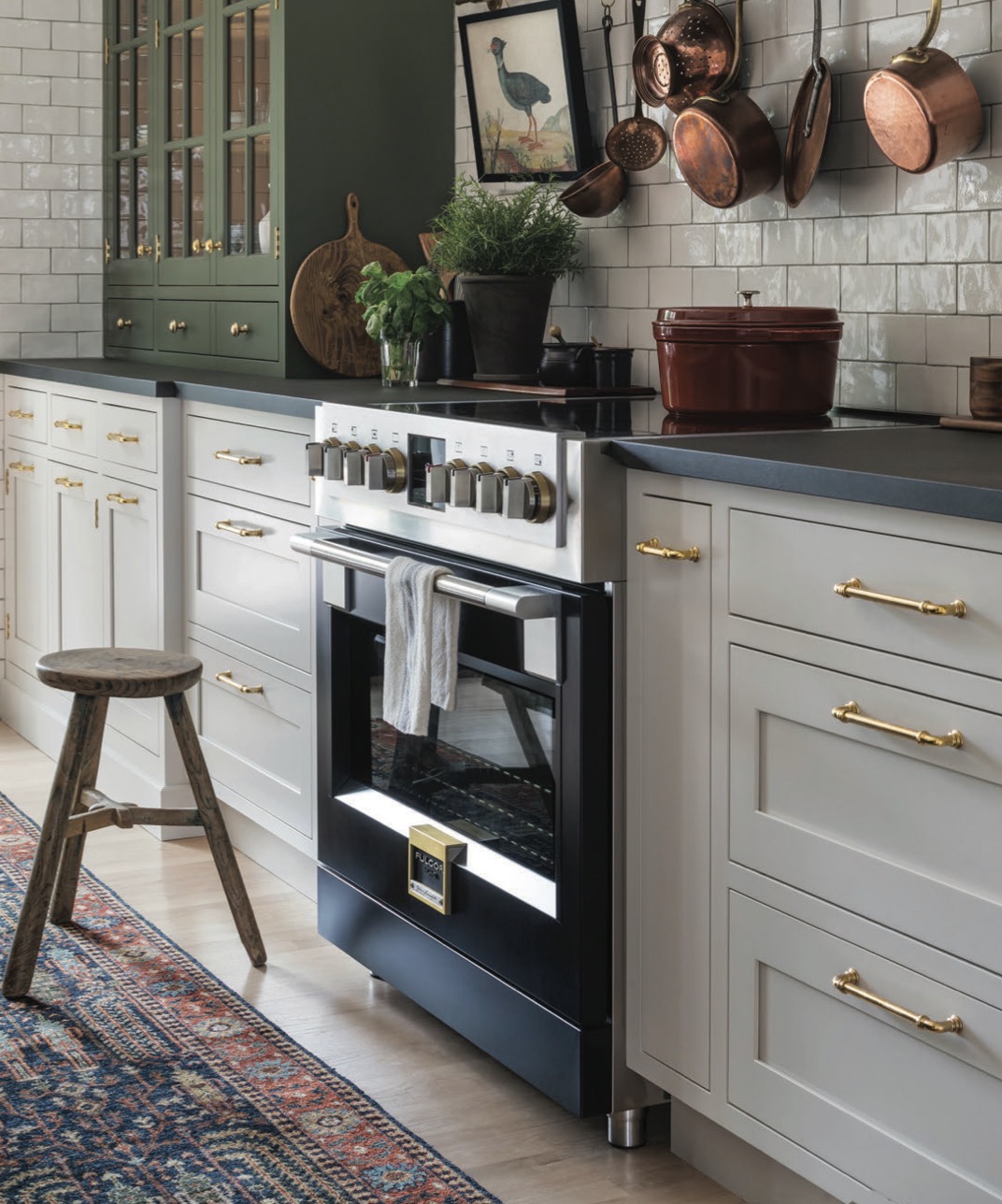 From necessity to the heart of the home
The kitchen has come a long way.
What began as a place of necessity—somewhere to prepare food—has evolved into one of the most important spaces in the home. Today, kitchens are gathering places, entertaining spaces, homework stations, conversation rooms, and often the true center of family life.
Cooking technology has evolved right along with them, moving from wood and charcoal to gas, electric, and now increasingly sophisticated induction systems.
For decades, gas has been considered the gold standard in luxury kitchens. There is something undeniably appealing about the visual flame and the familiarity of cooking over gas.
But technology has changed.
And as designers, our job isn’t to simply specify what has always been done. Our job is to understand what is next and determine whether it is right for our clients.
So, what exactly is induction?
Induction cooking uses magnetic energy to heat the cookware itself rather than heating the cooking surface and transferring that heat to the pan.
Under the glass cooking surface are magnetic generators. When induction-compatible cookware is placed on the surface, the magnetic field excites the metal in the cookware, creating heat directly within the pan.
The result is an entirely different cooking experience.
Rather than waiting for an element or flame to heat the pan, induction delivers heat directly to the cookware.
And that translates into some impressive benefits.
Speed
Induction can bring water to a boil remarkably quickly because very little energy is lost between the cooking surface and the cookware.
For a busy family—or anyone who entertains frequently—that responsiveness can make a noticeable difference.
Precision
Induction responds quickly when you adjust the temperature.
Think of it as the Ferrari of cooking technology: extremely responsive, powerful, and capable of making precise adjustments almost instantly.
This is particularly helpful when moving from a high-temperature sear to a delicate simmer.
Efficiency
One of the most compelling benefits is energy efficiency.
Induction cooking can reach approximately 90% efficiency, compared with significantly lower efficiency for traditional gas cooking.
That means more of the energy you’re paying for is actually being used to cook your food rather than escaping into the room.
For clients investing in a high-performance home, that matters.
A cooler, safer cooking surface
One of the most interesting differences with induction is what happens to the cooking surface.
With traditional electric cooking, the element becomes extremely hot and then transfers that heat to the cookware. The glass surface itself can remain dangerously hot after cooking.
With induction, the cookware generates the heat.
The cooking surface can still become warm because of heat transferred back from the pan, but it does not reach the extreme temperatures associated with traditional radiant electric cooking.
And because induction only activates when compatible cookware is detected, there is an additional layer of safety.
This can be particularly meaningful for households thinking about aging in place, accessibility, or multigenerational living—something we consider frequently when designing homes intended to serve families for many years.
Cleaning becomes dramatically easier
This may be one of my favorite benefits as a designer.
A sleek induction surface is essentially one continuous piece of glass.
No gas grates.
No burners to remove.
No crevices where food and grease collect.
And because the cooking surface isn’t being heated in the same way as traditional electric cooking, spills are less likely to become baked onto the surface.
In many cases, a wet cloth followed by a dry cloth is all that’s needed.
For a luxury kitchen, where clients have invested significantly in custom cabinetry, countertops, backsplashes, and architectural details, protecting those finishes from grease and cooking residue is important.
What about cookware?
This is one of the biggest adjustments for clients making the transition.
Induction requires cookware containing enough ferromagnetic material to interact with the magnetic field.
The easiest test?
Take a magnet.
If it sticks firmly to the bottom of the cookware, there’s a good chance it will work with induction.
Cast iron is often induction-compatible, as are many stainless-steel pieces.
The cookware should also have a relatively flat bottom for the best performance.
The good news is that many clients already own induction-compatible cookware without realizing it.
The ventilation conversation changes, too
This is where induction becomes particularly interesting from a design perspective.
Even though induction does not create combustion gases, ventilation is still essential.
Cooking produces steam, moisture, grease, odors, smoke, and airborne particles. Those need to be properly captured and removed from the home.
But induction eliminates the combustion byproducts and excess heat produced by gas cooking.
That can significantly change the ventilation requirements for a kitchen.
For example, a large gas range can require substantially higher CFM ventilation because of the BTU output of the burners. Induction generally requires less ventilation capacity.
That can open up new design possibilities.
A lower-CFM system can mean:
- Quieter kitchen ventilation
- Less conditioned air being exhausted from the home
- Greater flexibility in hood placement
- More options for islands and interior walls
- Smaller ductwork requirements in some applications
- Greater flexibility when creating a clean architectural aesthetic
This is particularly exciting for us because ventilation should be designed into the architecture—not treated as an afterthought.
Beautiful ventilation can be architectural
Ventilation doesn’t have to mean sacrificing the design of the kitchen.
Today’s options range from traditional chimney hoods to sculptural wall-mounted hoods, streamlined under-cabinet systems, integrated ceiling ventilation, and beautifully concealed solutions.
At S|A|M Interiors, we look at the entire composition.
The hood needs to perform, but it also needs to relate to the cabinetry, lighting, ceiling architecture, backsplash, sightlines, and overall aesthetic of the room.
The goal is simple:
Exceptional performance without compromising exceptional design.
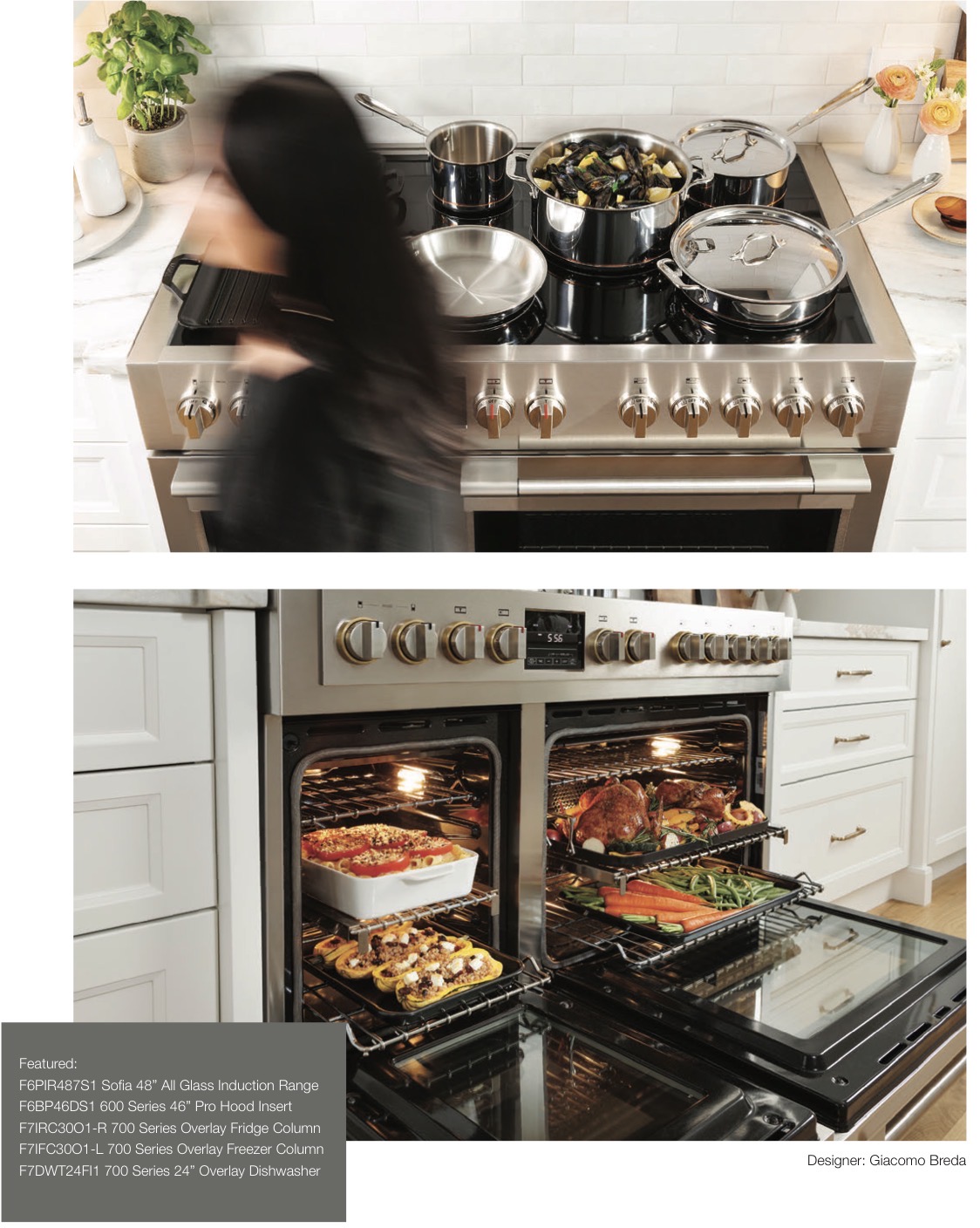
Induction also creates new opportunities for kitchen layouts
Because induction can require less ventilation infrastructure than a comparable high-BTU gas cooking system, designers may have greater flexibility when determining where the cooking surface can be located.
That can be particularly valuable when designing islands or kitchens where the cooking area isn’t positioned on an exterior wall.
Some induction surfaces also feature flush, minimalist designs that can visually disappear into the countertop.
Certain models can even allow portions of the surface to function almost like an extension of the countertop when they aren’t actively being used.
For an architectural interior, that kind of flexibility is exciting.
There is a learning curve
We would never recommend a new technology simply because it is new.
Induction does require some adjustment.
It heats quickly—sometimes much more quickly than clients expect. A pot of water can go from cold to boiling surprisingly fast.
The controls can also feel different from the knobs many homeowners have used for years.
And some induction systems can produce subtle sounds as the magnetic technology operates. Certain cookware can also create a slight buzzing or vibration, particularly inexpensive cookware with multiple layers that aren’t tightly bonded.
These are not reasons to avoid induction. They’re reasons to educate the client before making the selection.
Good design is informed design.
The ROI of a better-performing kitchen
When we talk about ROI at S|A|M Interiors, we’re not only talking about resale value.
We believe the return on investment in a home should be experienced every day.
With induction, that return can come in many forms:
Health: Reduced exposure to combustion byproducts and better management of indoor air quality.
Efficiency: More of the energy used goes directly toward cooking.
Comfort: Less excess heat released into the kitchen and potentially quieter ventilation.
Safety: A cooking surface that does not operate like a traditional open flame and can offer additional safeguards.
Maintenance: Easier cleaning and fewer components to remove and scrub.
Design flexibility: More opportunities to integrate cooking and ventilation into the architecture of the kitchen.
Longevity: Investing in technology that is increasingly becoming part of the future of residential cooking.
And perhaps most importantly, experience.
Because when our clients invest in a home, we want them to feel the value of those decisions every time they use it.
Designing for what’s next
As designers, we have a responsibility to keep learning.
We attend continuing education courses. We meet with manufacturers. We study new technologies. We talk to builders, architects, trades, and product specialists. We look beyond what’s trending and ask a more important question:
Will this make our client’s home better?
Induction cooking is a perfect example.
It isn’t necessarily the right choice for every client or every kitchen. Some homeowners will always prefer the visual experience of cooking over a flame. Others may love the familiarity of gas.
Our role isn’t to tell every client what they should choose.
Our role is to understand the options well enough to make the right choice for their home, their lifestyle, and their future.
That is what we mean by Excellence by Design.
At S|A|M Interiors, we design more than beautiful rooms. We create architectural interiors that are functional, personal, timeless, and built around the way our clients live.
Because the greatest return on a beautifully designed home isn’t simply what it is worth.
It’s what it gives back to you every day.





 Cooking Modes You’ll Find in a Convection Steam Oven
